Download from Bandcamp
Enter URL of the Bandcamp page below
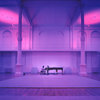
The Well-Tuned Piano in the Magenta Lights “87 V 10 6:43:00 PM — 87 V 11 1:07:45 AM NYC”
Includes unlimited streaming via the free Bandcamp app, plus high-quality download in MP3, FLAC and more.
"This [recording] captures the most important aspect of my work in composition that I have succeeded in recording to date. It is the yardstick against which all my other work must be compared."— La Monte Young
"The first choice is clear. I'm confident that La Monte Young's The Well-Tuned Piano will receive little competition as the most important and beautiful new work recorded in the 1980s. Young's achievement is unique, the recording a technological triumph."
— Kyle Gann, FANFARE November/December 1987
"La Monte Young's magnum opus, The Well-Tuned Piano is a solo improvised work that he performed live in public over 65 times between 1974 and 1987 in the Marian Zazeela light environment. Conceived in 1964, this work continued absorbing, evolving and expanding for over two decades until it flourished to its full structure in the '80s. Each performance was improvised by memory over an interwoven architectural form, which often inspired new material while performing. During the second decade, the scale of the work had expanded exponentially with a wealth of musical materials built from the organic confluence of both Western and Hindustani classical traditions. The keyboard of Young's Bösendorfer was sometimes stained with blood from his wounded fingers after a long performance. The 45-minute recorded version (1964) had gradually developed to a continuous 6-hour 25-minute virtuoso live performance in 1987. The Well-Tuned Piano is certainly the epitome of a justly tuned piano in the modern context that transcends the character and limitations of the instrument. While deeply rooted in the ancient traditions of aural primacy, tonal structure and modality, The Well-Tuned Piano delineated an unprecedented sustained harmonic resonance and a complex sonic epic that we had never before experienced."
— Jung Hee Choi, "La Monte Young, The Well-Tuned Piano,"
p. 36 of the booklet included with purchase of the recording.
La Monte Young pioneered the concept of extended time durations in 1957 and for over 60 years contributed extensively to the development of just intonation and rational number based tuning systems in his performance works; his work had a wide-ranging influence on contemporary music, art, and philosophy, including Minimalism, Fluxus, performance art, and Conceptual art.
Found tracks
Suggestions


|

|
|

|
|

|

|
|
|
|